You've set the habit. You tracked it for a week. You felt good. Then life happened — a bad day, a busy week, one skipped morning — and the streak was gone. Sound familiar? The problem isn't your willpower. It's that habits alone were never designed to survive the days you don't feel like doing them.
The myth of the self-sustaining habit
We've been sold a comforting idea: once a habit sticks, it becomes automatic. Twenty-one days, sixty-six days — pick your number. After that, it supposedly runs on autopilot. But research tells a more complicated story.
Habits do become easier with repetition, but they never become effortless in isolation. Every habit still requires a trigger — a cue that initiates the behaviour. And when life disrupts your environment, the cues disappear with it. You travel and your morning run evaporates. You work late and your evening reading never happens. The habit wasn't automatic. It was just riding a cue that no longer exists.
There's a deeper issue too. Most of the habits worth building are the ones we don't naturally enjoy. Journaling, stretching, cold showers, meditation, planning the week. These are the habits that produce the biggest returns — and the ones that lose the motivation battle almost every morning.
What a routine actually does
A routine doesn't replace motivation — it makes motivation irrelevant. Instead of asking "do I feel like doing this today?", a routine turns a group of habits into a single decision: start the routine. Once you've started, the sequence carries you forward.
This is called habit bundling — a term popularised by James Clear — and the psychology behind it is solid. When you pair a habit you avoid with a habit you enjoy, the enjoyed habit acts as a reward that pulls the avoided one along with it. You're not fighting your brain; you're using the reward circuits it already has.
But bundling goes further than just pairing two habits. A well-built routine creates a chain where each completed step makes the next one feel inevitable. The momentum of the routine becomes the motivation.
"You do not rise to the level of your goals. You fall to the level of your systems."
The boring-with-the-good trick
The most effective routines don't just stack habits randomly — they deliberately pair the ones you resist with the ones you look forward to.
Here are some real examples of how this plays out:
You hate stretching, but love your morning coffee
Put a 5-minute stretch between waking up and making coffee. The coffee becomes the reward that follows the stretch. Over time, the stretch stops feeling optional — it's just the thing you do before coffee.
You avoid journaling, but enjoy your evening wind-down playlist
Make journaling the entry point to music. Three minutes of writing, then the playlist starts. The music isn't a distraction — it's the signal that the hard part is done. You'll start looking forward to the journal because of what comes after.
You skip cold showers, but love feeling sharp and ready
Bundle the cold shower with something you genuinely like — your favourite podcast, a specific song that energises you, or the satisfaction of ticking off the first item of the day. Make the cold shower the gateway to the feeling, not the thing you dread in isolation.
You procrastinate on planning your day, but enjoy your morning scroll
Make phone access the reward that comes after planning. Five minutes to set your top three priorities for the day, then your phone is fair game. It sounds trivial, but flipping the order — plan first, reward second — changes the entire shape of your morning.
The sequence is the structure
What makes a routine more powerful than a list of habits is the sequence. When habits exist independently, every one requires a separate decision. When they're part of a routine, the decision is made once — and the sequence handles the rest.
Think of it like this: a pilot doesn't decide whether to run each checklist item during takeoff. The checklist runs, and each completed step triggers the next one. Your morning routine should work the same way. Wake up → hydrate → stretch → shower → plan → done. No deliberation. Just execution.
This is also why the first habit in a routine matters disproportionately. It sets the sequence in motion. For most people, making the first step extremely easy — almost embarrassingly small — is the difference between starting and not starting. A single glass of water. Opening the journal without writing a word. Putting on gym shoes while still sitting in bed.
Use your goals as fuel, not just your discipline
Here's something that rarely gets mentioned: on the hardest days, discipline isn't enough. Even well-built routines can stall when motivation hits zero. What pulls people back isn't willpower — it's reconnecting with why they started.
Keep something in your routine — or nearby — that reminds you of what you're actually building. A photo of the life you're working toward. An image of the goal you haven't reached yet. The finished product. The version of yourself you're becoming. When you lose momentum and ask yourself why you're doing all of this, look at that. Let the answer be visual, not abstract.
That's the difference between discipline-driven routines and purpose-driven ones. Both can build habits. Only one can outlast a really bad week.
What a good routine looks like in practice
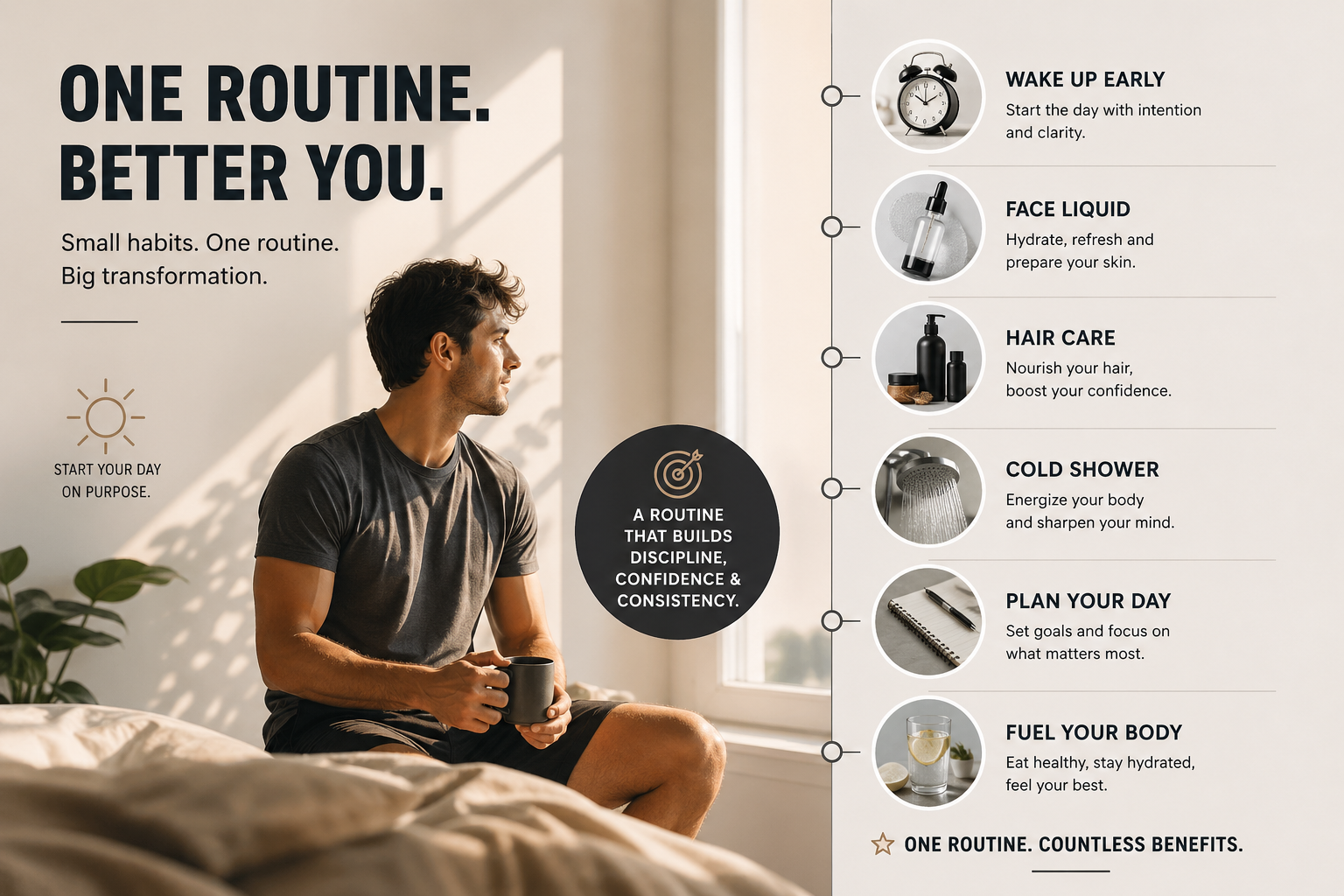
Here's a morning routine built on these principles — pairing the avoided with the enjoyed, keeping the sequence tight, and making the first step easy:
- 1
Wake up
No phone. One glass of water. The entry point is non-negotiable, and it costs nothing.
- 2
Face and skin care
A simple ritual that signals "the day has started." Fast, physical, sensory — it wakes the body up gently.
- 3
Cold shower
Hard, but short. Paired with the clarity it produces — which you've already experienced enough times to trust.
- 4
Hair and grooming
The "reward" after the shower. You feel put-together. Confidence is a byproduct of the sequence.
- 5
Plan your day
Three priorities. Five minutes maximum. Before the phone.
- 6
Fuel — water with lemon or breakfast
The final step that closes the routine and hands you over to the day.
Notice that no single step here is heroic. None of them require exceptional motivation. But together, done in sequence, they produce a version of your morning that compounds — and that starts to feel incomplete when skipped.
Start smaller than you think you should
The most common mistake when building a routine is making it too ambitious. Seven habits, ninety minutes, perfectly sequenced — and it falls apart the first time you sleep late or something runs over.
Start with three habits. Two you already do. One you want to build. Put them in sequence. Run that for three weeks. Only then consider adding more. A routine you actually do is infinitely more valuable than one you designed perfectly but can't sustain.
Build your routine in Merge Planner
Merge Planner lets you group habits into routines, set a single reminder for the whole sequence, and track your streaks across all of them together. One notification. One routine. One check-off.